What attributes does a hotel and a restaurant have before you would consider it to be a mountain biker friendly establishment? The following is a partial list of properties that I look for when looking for hotels/motels and restaurants when I do a mountain bike road trip.
Accommodations
Secure places to lock/store bikes
A lot of mountain bike tourists will travel with their bikes - which may be worth up to $5K. Leaving these bikes locked outside or on a car is not an option. Some of the better hotels I have stayed in will have a secure bike storage locker in the hotel near the entrance with the concierge escorting the cyclist to the locker. For motels, I have always brought my bike into the room. This tends to be tricky when you have 4 riders in a room. It's not unusual for mountain bike tourist to bring more than one bike. I'll usually take 2 bikes on a solo road trip but 1 bike if I fly. On one road trip to Vancouver/Whistler a few years ago, 2 of my friends packed a mini-van with 5 bikes - 2 bikes each and a spare.
Convenient place to wash/work on bikes
More often than not, we may work on our bikes before or after a ride. This could be as simple as lubricating a chain or more complex maintenance which involves tools and a bike stand. When we do a road trip we prefer to stay in motels rather than hotels. We usually prefer a ground floor unit. The room is close to the car (where we store tools and bike stand) and it's easier to put the bike in the room.
Close proximity to trails and nice restaurants
I'm a cyclist so when I get to a destination I don't really want to drive everywhere. Riding to the trail head is ideal. Walking/riding to restaurants is also favorable. Added bonus is to be close to local bike shops for trail knowledge and local maps and wares.
Camping
Camping is always a favorite activity of mountain bikers. Bikers travel with a lot of gear so car camping is preferable. I really don't know of any great places for car camping which is close to riding areas in Santa Cruz. I know that there are campsites at Henry Cowell but I haven't seen them nor have I heard of any mountain bikers who use them.
Restaurants
Secure place to lock the bike
Finding a safe place to lock the bike outside of the restaurant is essential. Santa Cruz is notorious for the bike theft. I hear about a sweet ride being pinched from downtown Santa Cruz on weekly basis. Sometimes they will cut the cable lock while the bike is still on the car. I like 99 Bottles and Seabright Brewery since they have bike racks in front of the patios. It's not unusual to see pricey rigs in these racks.
Good beer and hearty food
Mountain bikers are (mostly) athletic and they do pay attention to the type of fuel they put in their bodies. Beer and hearty road house food - burgers, pasta and Mexican food - are great to refuel after a long ride. There seems to be a cultural aspect of good beer and mountain biking. Brew pubs are a huge hit with mountain bikers.
Social atmosphere
Many of the big group rides I have attended during the week usually end at some pub/restaurant where there is a recounting of the ride around beer and finger foods. A pub type atmosphere is good here since people will be moving around.
Willingness to put up with dirty, stinky and potentially bloody people
Very often, mountain bikers will ride to a restaurant after the ride since they are pretty hungry. They may be covered in grime and trail dirt but at least they don't smoke (unless they're European). Again, the patio is a good thing.
Some examples of Bike Friendly Places
Whister, BC, Canada - the ultimate mountain biker destination - have hotels which specifically cater to the mountain bike tourist. Not only do all these hotels and lodges have secure storage for bikes but they also have cameras and motion detectors. They also bring up another good feature: laundry facilities.
This Forest Freeride Bunkhouse in Wales sounds like a great place to stay. Not only is this place near trails but there is a BBQ area outside. Wales is a place that really "gets" mountain bike tourism. Scotland is another great mountain biking destination that has made the effort to make mountain bike tourists feel welcome. This impressive listing of accommodations breaks it down into categories like hotels, B&Bs, camping and bunk houses.
In Santa Cruz, my favorite bike friendly restaurants are the above mentioned 99 Bottles and Seabright Brewery. For faster food, I like Taqueria Santa Cruz (although I hear that Taqueria La Cabana - across from ABS - is definitely worth checking out) and the Summit Store for a post ride snack after riding at Soquel Demo Forest.
Do you have any other features that you like to see in accommodations and restaurants when you travel with your bike? Can you recommend places to stay and eat in Santa Cruz which you deem to be mountain bike friendly? Please post some comments and share them.
Showing posts with label economic. Show all posts
Showing posts with label economic. Show all posts
Tuesday, September 11, 2007

Thursday, July 12, 2007
Yuppies are the target market
 A few weeks ago the New York Times travel section had a great article on mountain biking in Fruita, Colorado. This article is practically a brochure for mountain bike tourism in Fruita and sounds like it could have been written by the chamber of commerce. It's also notable that this article appears in the New York Times - which is not your typical mountain bike rag. Fruita is targeting yuppies who are looking for an adventure vacation. These types of tourists would go on active eco-vacations like skiing, white water rafting, hiking and mountain biking. These are the same people we would love to bring to enjoy the trails of Santa Cruz County.
The inspiration for Fruita embracing mountain bike tourism is mentioned in the article:
Just over 10 years ago, Fruita was a depressed agricultural town with an oil refinery being shut down by the Environmental Protection Agency. Then, Troy Rarick, a 44-year-old cyclist from nearby Grand Junction, conceived a plan to transform Fruita by giving it a new identity: ecotourism hub.Fruita has several hundred miles of single-track and is widely recognized as one of the premiere mountain bike destinations in the world. That town does a great job of attracting mountain bike tourists. They have an amazing Fat Tire Festival that continues to bring in a lot of revenue. I know of a lot of mountain bikers who have made the trek to Fruita in the past few years and they have all enjoyed their stay. Mountain biking is a source of civic pride for Fruita and they have bike murals and sculptures on the main street.
The town of Fruita inspires me that Santa Cruz can similarly embrace this brand of eco-tourism and we can all grow the global market for mountain bike tourism. Perhaps some day the New York Times will be writing about Santa Cruz and the swoopy single track dancing in and out of the redwood trees with blades of sun piercing though the morning fog.
 That would be sweet!
Thursday, June 21, 2007
Sea to Sky Mountain Biking Economic Impact Study
 About 6 months ago, I blogged about the Yukon Study about the economic potential of mountain bike tourism. That study analyzed the potential and demographics of the global mountain bike tourism market. It was a great document which used market research to identify the mountain bike tourist and contained case studies of communities which embraced mountain bike tourism. It was a great document to introduce a community to the potential of mountain bike tourism and want to know more about the market.
Earlier this year the Western Canada Mountain Bike Tourism Association (MBTA) released a study which illustrates the economic benefits of a mature mountain bike tourism industry. This study complements the Yukon study in that it shows the economic results for Whistler, BC - a community which embraced mountain bike tourism.
The economic impact study gives credible data on the economic benefits of mountain bike tourism. The executive summary states (all numbers in Canadian dollars (1 US$ = 0.93 CD$) ):
"Total visitor spending in Whistler attributable to mountain biking exceeded $34.3 million over the period June 4 to September 17, 2006 supporting an estimated $39.1 million in new economic activity (GDP)."
Not a bad summer season! Whistler continues to be a positive draw of the global mountain bike tourism market. This study discusses the survey methodology, breaks down visitor origin, size of the party, number of nights stayed and spending per visitor. The benefits of out of town visitors to a community can not be overstated:
"The study found that mountain biking draws visitors to Sea to Sky communities and generates significant overnight stays. Overall, 20% of non-resident riders stayed overnight in Sea to Sky communities, staying an average of 4.8 nights and having an average party size of 2.8 people."
It emphasizes the need for authorized trails in order for the tourism economy to succeed:
"The authorized trail system in the Whistler Valley generates considerably more economic activity than the trail systems in Squamish and the North Shore where few authorized trails exist. Whistler has been able to capture higher visitor expenditure in part by having the ability to promote its municipal trails and associated services (bike rentals, guides, camps, etc) directly to visitors both within the Resort and externally."
The bottom line of the study is something that should please local business and government:
"In total, mountain biking has a sizable impact on the summer economy of Whistler and British Columbia, with total expenditures totaling more than $34.3 million between the valley trails, the Bike Park, and Crankworx. This spending generated more than $39.1 million in economic activity, and supported more than $26.5 million in wages and salaries and 798 jobs throughout the Province. Mountain biking in Whistler also supported considerable tax revenues, with over $8.5 million and $7.3 million in government taxes paid at the federal and provincial levels, respectively; while municipal revenues throughout the province exceeded $2.1 million."
These numbers only shows the direct economic impact of tourism. However, I'm sure there are further benefits to the BC bike industry due to the world class mystique of the free ride style of riding. Rocky Mountain, Norco, Cove Bikes and Brody have probably benefited from being part of the BC bike culture which exploding onto the public consciousness around 1998. Many visitors were introduced to the local bikes and may consider taking a bit of BC's finest back with them.
10-15 years ago I lived in Vancouver and rode the Whistler and North Shore trail systems when they were unauthorized. Back then only the locals rode the trails and there were very few tourists (friends of friends). In 10 years, revenue from mountain bike tourism in the Sea to Sky area has gone from immeasurable to CD$39 million.
These are impressive numbers and I really believe that Santa Cruz County has the potential to realize a similar level of mountain bike tourism economic activity.
Friday, June 15, 2007
Mountain Bike Tourism in Santa Cruz County
 The Santa Cruz weekly newspaper Good Times has an article about MBOSC this week. This article makes it public that the focus of our organization is the promotion of mountain bike tourism as a sustainable economic activity for Santa Cruz County. We have been developing a tourism initiative for a while now among ourselves so we may as well explain our strategy.
Mountain bike tourism is a global market and a sustainable economic activity. Communities from all over the world are recognizing the economic potential of this form of eco-tourism and have been embracing it to revitalize their local economies.
Santa Cruz has so many natural advantages for the development of mountain bike tourism including:
- A tourism based infrastructure already in place
- Nearby greenbelt areas and parks within riding distance of hotels and motels
- Spectacular redwood single track and coastal views
- Alternative activities for non-biking guests and family members
- Supportive bike industry and bike culture
- World-class destinations including San Francisco, Monterey and Silicon Valley less than 2 hours away
- City of Santa Cruz: More hotel and sales tax revenue.
- Local bike industry: increased sales and opportunities for new businesses.
- Local businesses: hotels, restaurants and tourism.
Mountain biking is a healthy, eco-friendly, and fun form of outdoor recreation and it should be encouraged for its low-cost, low impact use of public and private land. Santa Cruz is well known as a mountain biking destination to active mountain bikers in Northern California. The city and county can market Santa Cruz as a world-class mountain bike destination with very little investment and effort.
Monday, October 30, 2006
Yukon study about the Market Potential for MTB Tourism
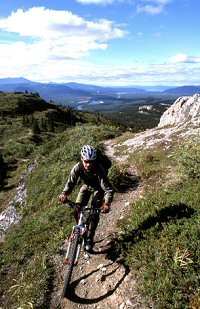
I've been pretty excited about the potential for developing mtb tourism for Santa Cruz county. I believe that tourism is the best framework in order to open more trails and create more volunteer participation in advocacy and trail work. I believe that mountain bike tourism has the potential to develop more economic activity for the local bike industry and the tourism economy of Santa Cruz.
The other day I did a Google search to find information on the demographics of people who would engage in mountain bike tourism. I hit a gold mine when I found this document from the Yukon Tourism and Culture resource center:
Exploring the Market Potential for Yukon Mountain Bike Tourism (PDF 51 pages, 5.05MB)
(NOTE: printing this document pegged my printer at work for about 45 minutes due to the white on black section boxes)
This is a recent document (March 2005) and it's quite comprehensive. Even if you aren't interested in developing a tourist destination, this is a good overview of the demographics of mountain bikers.
Part 1 discusses the history and global demographics of mountain biking. Part 2 talks about the economic impact of various mountain bike related events. Part 3 has case studies of existing mtb destinations and some lesson learned for aspiring destinations. Part 4 and 5 discusses the assets of the Yukon Territories and outlines a strategy for how they can capitalize on the mountain bike tourism market.
When you look at the geographic and logistical challenges facing the Yukon to implement this plan, it seem much easier for Santa Cruz to develop and market itself as a mountain bike destination.
Subscribe to:
Posts (Atom)
